What Actually Happens During a Commercial Fire Sprinkler Inspection
A facilities manager's guide to what a technician does during a scheduled sprinkler inspection, and why the tag on the riser matters.
September 2, 2026 · 4 min read
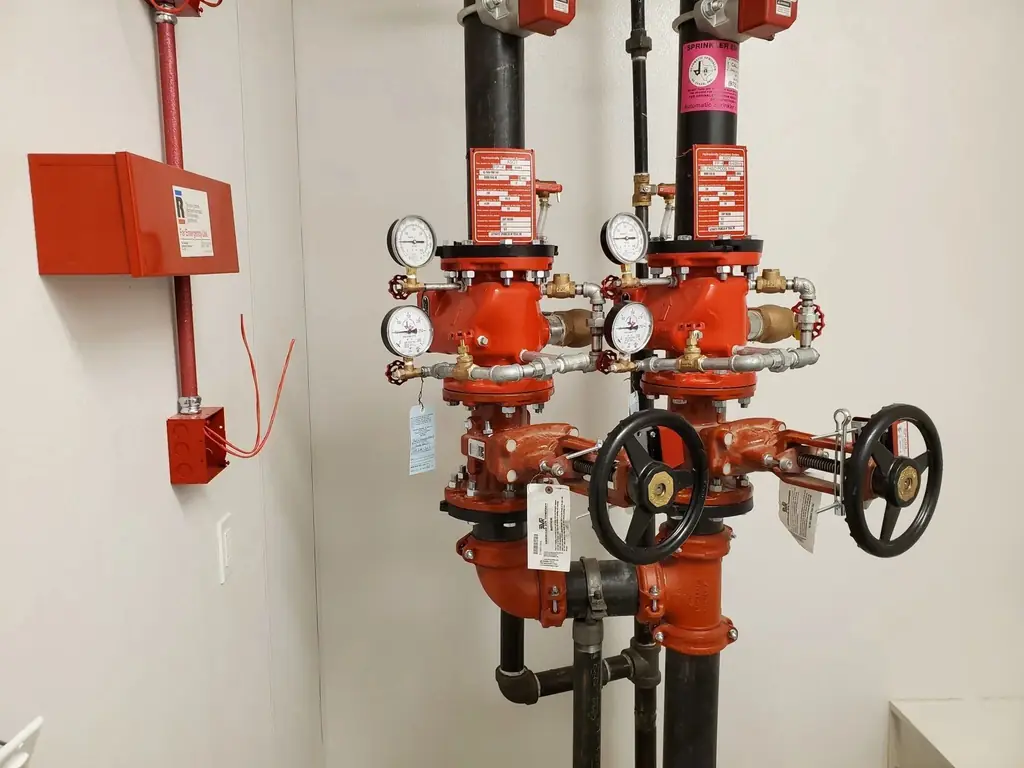
Most people who manage a commercial building have never actually watched a fire sprinkler inspection happen. The tech shows up, disappears into the riser room for a while, walks the building, and leaves a report. Here is what happens in between, so the next visit makes more sense.
It starts in the riser room, not on the ceiling
Every wet sprinkler system has a riser: the vertical pipe where water enters the building's fire protection piping. Around it sits the equipment that actually runs the system, an alarm check valve, gauges reading supply pressure and system pressure, and OS&Y (outside stem and yoke) control valves that show at a glance whether the system is open or shut. A technician's first job is reading that equipment, not looking at ceiling heads. If the gauges do not agree with what they should, everything downstream is a footnote until that gets resolved.
What the tag actually records
Somewhere on or near the riser is a tag, usually a small metal or card tag with punch-out or written fields. It is not decoration. It is a running record of who tested the system, when, and what they found, the same idea as an oil change sticker, except the thing being maintained can be the only thing standing between a small fire and a total loss. On our own completed jobs, that tag carries our company name and phone number tied to the date and the specific job, which is deliberate. If a question ever comes up about that system, there is a name attached to the answer.
From the riser to the remote head
Once the riser checks out, the walk moves outward through the building, tracing branch lines to whichever sprinkler head sits at the hydraulically most remote point of the system. That head matters because it is the hardest one for the system to reach with adequate pressure and flow. A flow test run from that point tells you more about how the system will actually perform in a fire than a test run anywhere closer to the riser.
What a technician is actually looking for along the way
- Control valves in their correct position and, where required, supervised or locked so they cannot be closed accidentally
- Static and residual pressure readings that match what the system was designed and hydraulically calculated to deliver
- Individual heads checked for paint overspray, corrosion, physical damage, or anything stored close enough to block their spray pattern
That last point sounds minor until you have seen a sprinkler head buried under stacked inventory or painted over during a remodel. Either one can quietly take a functioning system out of service without anyone noticing, until it is tested or until it is needed.
It does not end at the riser
Inspections do not happen in isolation from the rest of a building's water supply, either. Many commercial sprinkler systems tie into a domestic or fire water main through a backflow prevention assembly, itself an inspected component with its own test schedule and its own failure modes. Our team includes backflow prevention assembly testers licensed with the TNRCC, because a riser inspection that ignores what happens where the system connects to the water supply is only half the picture.
A system's original hydraulic calculations, done at design time by a certified designer, are the baseline every later inspection gets measured against. Our design department is NICET-certified up through Level IV in water-based systems layout, which means when we inspect a system we did not originally design, we are reading someone else's calculations against the same standard we would apply to our own.
After the walk
The technician writes up findings, notes anything that needs correction, and the tag gets updated. Inspection frequency and specific compliance requirements vary by system type, occupancy, and the authority having jurisdiction for that building, so we will not print a blanket schedule here, your AHJ and your system's classification set that. What we can tell you is what good record-keeping looks like: a tag that is current, a report that is specific, and a contractor who can be reached if a question comes up eighteen months later.
Automatic Sprinkler of Texas, Inc has been doing this work out of Duncanville since 1995, with a NICET-certified design department up through Level IV and a licensed inspection and testing team. We are employee-owned, which is not a marketing line, it means the tech in your riser room has a stake in the company whose name is on that tag. If it has been a while since anyone walked your system riser to remote head, call us and we will.
Automatic Sprinkler of Texas, Inc — (972) 298-2772
Call (972) 298-2772More articles
Wet, Dry, Pre-Action and Deluge: Why Your Building's Use Decides the System
Four different ways to get water onto a fire, each one solving a different problem your building already has.
Trouble, Supervisory, or Alarm: What Your Fire Alarm Panel Is Actually Telling You
Three different signals on your panel mean three different things, and only one of them means evacuate.